
The Start

Pottery is one of humanity’s oldest and most enduring forms of creativity. Long before people built modern cities, developed written languages, or created machines, they were already gathering clay from the earth and shaping it into useful objects.
At first glance, a clay bowl may seem simple. However, the discovery that soft earth could be shaped and permanently hardened by fire was an important technological breakthrough. Pottery allowed people to cook food, boil water, store grain, transport liquids, preserve supplies, and create objects for ceremonies and celebrations.
Over thousands of years, pottery grew from a practical survival tool into a skilled craft, an important industry, and a respected form of artistic expression. Nearly every region of the world developed its own pottery traditions, using local clay, available minerals, cultural symbols, and firing methods.
The history of pottery is not simply the story of bowls, jars, and cups. It is the story of human curiosity, experimentation, community, trade, and creativity.
Before Pottery: Discovering the Possibilities of Clay
Clay is a naturally occurring material formed as rocks slowly break down over extremely long periods. When mixed with the right amount of water, clay becomes soft and moldable. It can be pressed, rolled, carved, pinched, or shaped into many different forms.
Early people would have encountered clay near rivers, lakes, floodplains, and other wet areas. They may have noticed footprints, handprints, or tool marks remaining in the clay after it dried in the sun.
They may also have used clay for purposes other than containers. Clay could be used to seal gaps, line cooking areas, coat woven baskets, form small figures, or create simple building materials.
At some point, people discovered that clay exposed to intense heat changed permanently. Instead of simply drying and becoming soft again when wet, fired clay became hard and durable.
The exact circumstances of this discovery are unknown. It may have happened when clay-lined baskets, clay-covered food, small clay objects, or pieces of clay soil were placed near a fire. Whatever the cause, people eventually recognized that fire could transform clay into a new material.
That transformation became the foundation of pottery.
When Was the First Pottery Made?
There was no single inventor of pottery whose name was recorded. Pottery developed over long periods of experimentation, and evidence suggests that ceramic traditions appeared in different areas at different times.
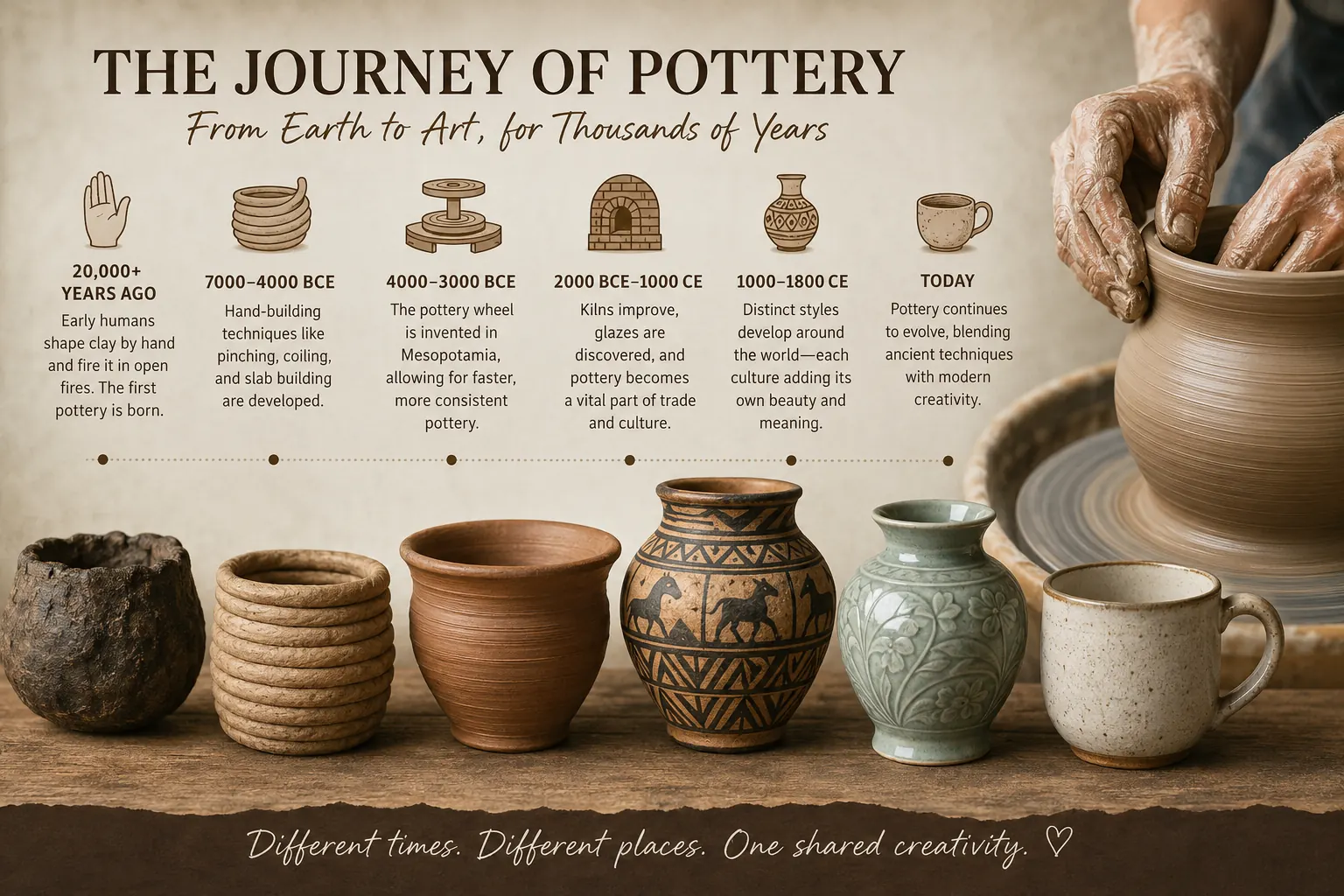
Some of the oldest known pottery fragments were discovered at Xianrendong Cave in Jiangxi Province, China. Researchers dated the archaeological layers containing these fragments to approximately 20,000 to 19,000 years ago. The people who produced them were mobile hunter-gatherers living during the last Ice Age, thousands of years before agriculture became widespread. Researchers believe some of these early vessels may have been used for cooking.

Other very early pottery traditions developed in East Asia. The Smithsonian notes that some of the oldest known pottery from the region is approximately 18,000 years old. Early ceramics have been found in areas of present-day China, Japan, and the Russian Far East.
These discoveries changed an older assumption that pottery began only after people settled into farming villages. Instead, some hunter-gatherer communities were already making pottery while moving between seasonal camps.
This raises an interesting question: Why would mobile communities make heavy, breakable containers?
The answer may have been cooking. A fired clay vessel allowed food to be boiled slowly over a fire. This could make tough plants, roots, meat, fish, and other foods easier to eat and digest. It could also allow fats, nutrients, and flavors to remain in a meal instead of being lost directly into a fire.
Even a rough clay pot could dramatically expand the types of food a community could prepare.
From Hunter-Gatherers to Farming Communities
Although pottery existed before agriculture in some regions, it became especially important as people began living in permanent settlements.
Farming communities needed dependable ways to store harvested grain, seeds, dried food, oils, water, and fermented beverages. Pottery provided a solution. A well-made vessel could protect supplies from moisture, insects, rodents, contamination, and daily handling.
Permanent communities could also invest more time in pottery production. Potters no longer needed every vessel to be lightweight enough to carry constantly. They could make larger storage jars, heavier cooking pots, serving dishes, and specialized containers.
In Mesopotamia, pottery was being made and used for preparing, serving, and storing food by approximately 7000 to 6000 B.C. Later Mesopotamian cultures produced increasingly elaborate painted pottery, including finely decorated pieces associated with the Halaf culture.
As villages grew, pottery became part of the daily rhythm of community life. Clay had to be gathered, cleaned, mixed, shaped, dried, decorated, and fired. These steps required knowledge, patience, and cooperation.
Pottery production gradually became a specialized skill.
How the Earliest Pots Were Made
The first pottery vessels were not made on spinning pottery wheels. They were formed entirely by hand.
Early potters developed several basic techniques that remain popular with ceramic artists today.
Pinching
Pinching is one of the simplest pottery methods. A potter begins with a ball of clay, presses a thumb into the center, and gradually pinches the clay outward and upward.
By carefully rotating the piece and controlling the pressure of the fingers, the potter can form a small bowl, cup, or container.
Although the process sounds simple, producing even walls and a balanced shape requires practice.
Coiling
The coiling method allowed early potters to make larger vessels.
Clay was rolled into long, rope-like coils. These coils were placed on top of one another to build the walls of a container. The potter then pressed and smoothed the coils together.
A vessel could be made wide, narrow, rounded, tall, or tapered depending on how the coils were positioned.
Coiling was especially useful for creating large storage jars that would have been difficult to form from one solid piece of clay.
Slab Building
Another method involved flattening clay into slabs and joining the pieces together.
Slab construction could be used to make boxes, trays, flat-bottomed containers, architectural decorations, and other forms with straighter sides.
Molding and Pressing
Clay could also be pressed into baskets, pits, existing containers, or specially made molds. The supporting form helped the clay maintain its shape until it dried enough to be removed.
Each method gave potters a different way to control the clay. These techniques were often combined, depending on the object being made.
The Importance of Tempering Clay
Natural clay is not always ready to use immediately. Some clay is too sticky, too smooth, or too likely to crack as it dries.
Early potters learned to mix other materials into the clay. These added materials are often called temper.
Temper could include sand, crushed stone, shells, plant fibers, previously fired pottery fragments, or other locally available materials. Adding temper could reduce shrinking, improve strength, change the texture, and help a vessel survive drying and firing.
This knowledge was usually developed through repeated trial and error.
A potter might discover that clay from one riverbank worked well for small bowls but cracked when used for large jars. Clay from another location might survive firing but be difficult to shape. Mixing materials allowed potters to adjust the clay for a particular purpose.
This was an early form of material science, even though ancient potters would not have used that term.
Drying the Pottery
Before a clay object can be fired, much of its water must evaporate.
If a wet pot is placed directly into a hot fire, the water trapped inside the clay can quickly turn into steam. The pressure may cause the piece to crack or explode.
Early potters had to learn how long different pieces needed to dry. A thin bowl might dry quickly, while a thick storage jar could require much more time.
Drying also had to be controlled. If one side dried faster than another, the piece could warp or crack. Potters might place their work in the shade, cover it loosely, rotate it, or protect it from strong wind and direct sunlight.
Learning to manage moisture was just as important as learning to shape the clay.
Modern potters still face the same challenge. Clay must dry slowly and evenly before it enters the kiln.
The First Firing Methods
The earliest pottery was probably fired in open fires or shallow pits.
The dried pots could be placed among wood, grass, brush, animal dung, or other combustible materials. The fire would then be built around and over the pottery.
Open firing could successfully harden clay, but it was difficult to control. Wind, weather, fuel, placement, and temperature all affected the outcome.
Some pieces might fire properly, while others remained weak, cracked, warped, or broke completely.
Smoke, ash, and changes in oxygen could also affect the color of the pottery. Depending on the type of clay and the firing atmosphere, vessels might emerge red, orange, tan, gray, brown, or black.
These changes may have first appeared accidentally. Over time, potters learned to influence them.
For example, limiting oxygen near the end of a firing could darken the clay. Allowing more oxygen could produce brighter red or orange colors in iron-rich clay.
Fire was not simply a tool that hardened the pottery. It became another part of the creative process.
The Development of the Kiln
An open fire loses a great deal of heat to the surrounding air. A kiln creates a more enclosed space where heat can be concentrated and controlled.
Early kilns were likely simple structures or pits designed to protect pottery from direct flames while holding heat around the pieces. Over time, kiln designs became more advanced.
Some kilns separated the pottery from the fuel. Hot air and gases moved through the firing chamber while the vessels remained on platforms or shelves. Potters could control airflow with openings, vents, and chimneys.
Kilns allowed pottery to be fired at higher and more consistent temperatures. This created stronger products and reduced the number of failed pieces.
The kiln also allowed potters to experiment with different clay bodies, surface treatments, and glazes.
However, firing remained risky. A potter could spend days or weeks preparing a group of vessels, only to lose them during firing because of cracks, uneven heat, collapsing shelves, improper airflow, or sudden temperature changes.
The uncertainty of firing is still familiar to ceramic artists today.
Decoration Before Glaze
Early pottery was not always plain. Potters quickly began decorating the surfaces of their vessels.
Designs could be scratched or carved into damp clay. This is known as incising.
Potters also pressed objects into the clay to create impressions. Shells, cords, woven materials, sticks, bones, stones, fingernails, and handmade stamps could produce repeating patterns.
Some vessels were polished with a smooth stone or tool. This technique, called burnishing, compressed the clay surface and created a soft shine.
Colored clay mixtures or mineral-rich washes could be applied to the surface. These coatings are often described as slips. Slips allowed potters to change the color of a piece or create painted patterns before firing.
Decoration could serve many purposes. It could make a common object more beautiful, identify its maker, indicate what it contained, show that it belonged to a particular community, or communicate a religious or cultural meaning.
Patterns were rarely meaningless. Lines, circles, animals, plants, human figures, and geometric shapes often reflected the world in which the potter lived.
The Invention of the Pottery Wheel
One of the most important developments in ceramic history was the pottery wheel.
Early rotating devices were probably simple turntables. The potter could slowly rotate a vessel while shaping or decorating it. This was easier than repeatedly walking around the piece or turning it by hand.
In southern Mesopotamia, pottery was being produced on slow wheels during the Ubaid period. By approximately 4000 to 3500 B.C., the Uruk culture was producing pottery in greater quantities using fast wheels and molds.
The fast pottery wheel allowed a skilled craftsperson to center a lump of clay and shape it while it rotated. The force of the spinning wheel helped create rounded, symmetrical forms.
Wheel throwing made it possible to produce bowls, cups, jars, and other vessels more quickly and consistently.
This did not eliminate hand building. Handles, spouts, lids, feet, decorations, and sculptural elements were still commonly made by hand and attached later.
The pottery wheel changed the organization of pottery production. Instead of every household making all of its own vessels, specialist potters could produce larger quantities for sale or trade.
Pottery became an occupation as well as a household skill.
Pottery, Trade, and the Growth of Cities
As cities developed, people needed enormous quantities of containers.
Pottery was used to store grain, oil, wine, water, medicine, spices, perfume, and other products. Clay containers were used in homes, workshops, markets, ships, temples, and government storage areas.
Because pottery was relatively affordable and could be made in many sizes, it became one of the ancient world’s most common manufactured products.
Pottery also traveled.
A jar made in one region might be transported hundreds or thousands of miles with the product it contained. Archaeologists can study the clay, shape, decoration, and manufacturing marks to determine where a vessel was made.
Finding pottery from another region can provide evidence of trade, migration, political influence, or cultural exchange.
A broken pottery fragment may seem insignificant, but it can reveal where people traveled, what they bought, what they ate, and which communities interacted with one another.
Pottery as an Archaeological Record
Pottery is extremely important to archaeologists because fired clay can survive for thousands of years.
Wood rots. Fabric decomposes. Food disappears. Metal may corrode or be melted and reused. Pottery often breaks, but the broken pieces remain in the ground.
These pieces are called sherds.
Archaeologists can examine the shape, thickness, color, decoration, clay composition, and firing method of a sherd. Pottery styles often changed over time, allowing researchers to compare pieces and estimate when an archaeological site was occupied.
Residue inside a vessel may provide evidence of what it once contained. Smoke marks can suggest that a pot was used for cooking. Wear around a handle may show how it was carried. Repairs may indicate that the vessel was valuable enough to preserve after it cracked.
Even an ordinary cooking pot can provide a detailed record of daily life.
Pottery in Ancient Egypt
Pottery played a major role in ancient Egyptian homes, farms, workshops, religious sites, and tombs.
Egyptian potters used clay gathered from the Nile region and surrounding desert areas. Different clays produced different colors and qualities after firing.
Vessels were used to store food, water, oils, cosmetics, medicines, beer, wine, and offerings. Some were simple household objects, while others were carefully decorated for ceremonial or funerary use.
Pottery also appeared in tombs because food, drink, and other supplies were believed to be important in the afterlife.
The dry climate of Egypt helped preserve many ceramic objects, giving historians a valuable view of ancient Egyptian life.
Greek Pottery and Painted Storytelling
Ancient Greek pottery is especially famous for its painted scenes.
Greek potters produced many specialized vessel shapes. Some were designed for storing oil or wine. Others were used for mixing beverages, carrying water, serving food, drinking, or holding perfumes.
The shape of a vessel often communicated its intended purpose.
Greek vase painters decorated pottery with scenes from mythology, warfare, athletic competition, ceremonies, music, family life, and everyday activities.
In the black-figure technique, figures were painted in a dark slip and details were scratched into the surface. Around 530 B.C., Athenian artists developed the red-figure technique. In this method, the background was darkened while the figures remained the natural red color of the clay. Artists could use brushes to create more detailed anatomy, clothing, movement, and facial expressions.
These vessels were functional, but they were also storytelling objects.
Much of what historians know about ancient Greek clothing, athletics, ceremonies, warfare, and mythology comes from scenes preserved on pottery.
Roman Pottery and Large-Scale Production
The Roman world required vast quantities of pottery.
Roman potters produced cooking pots, lamps, roof tiles, tableware, storage jars, and large transport containers known as amphorae.
Amphorae carried products such as wine, olive oil, fish sauce, and grain throughout the Roman trade network. Their shapes varied by region and product, allowing modern archaeologists to trace trade routes.
Some Roman pottery was mass-produced in workshops using molds. Decorative tableware could be produced in large quantities and distributed across great distances.
Pottery had become a major industry supported by organized labor, transportation networks, markets, and specialized production centers.
Chinese Ceramics and the Development of Porcelain
China developed some of the most technically advanced ceramic traditions in history.
Chinese potters experimented with refined clays, high firing temperatures, kiln design, glazing, painting, and decorative techniques over many centuries.
One of their greatest achievements was porcelain.

Porcelain is generally made with carefully prepared materials, including kaolin-rich clay, and fired at very high temperatures. The result can be strong, smooth, white, and sometimes slightly translucent.
The British Museum dates the first production of porcelain in China to around A.D. 600. Chinese ceramics were produced for the imperial court, domestic buyers, and international export.
Chinese porcelain became highly prized in other parts of Asia, the Middle East, Africa, and Europe.
Blue-and-white porcelain became especially famous. Cobalt decoration was painted onto the vessel before a clear glaze was applied and fired. The contrast between the deep blue designs and the white porcelain body created a distinctive appearance that was widely copied.
For centuries, European potters attempted to reproduce true Chinese porcelain. The technical knowledge required to make it remained difficult to duplicate.
Pottery in Japan
Japan has one of the world’s oldest continuous ceramic traditions.
Early Japanese pottery is closely associated with the Jōmon culture. The name Jōmon is commonly connected to cord-marked decoration, which appeared when cords or woven materials were pressed into the clay.
Jōmon potters produced hand-built vessels with a wide variety of forms and surface patterns. Some later pieces included dramatic rims, sculptural additions, and complex decoration.
Japanese ceramics continued to develop through contact with Korea, China, and other regions. Potters adopted and transformed new technologies, including advanced kilns, glazing methods, and wheel throwing.
Over time, Japanese pottery became closely connected to food presentation, tea culture, religious practice, architecture, and everyday life.
Japanese ceramic traditions often emphasize the natural qualities of clay, glaze, texture, and fire. Irregular shapes, visible tool marks, and unpredictable glaze effects may be appreciated rather than treated as flaws.
Pottery in Korea
Korean potters made major contributions to ceramic history, particularly through celadon, stoneware, porcelain, and large storage vessels.
Korean celadon became famous for its soft green glaze. Potters developed sophisticated decorative methods, including carving and inlaying designs into the clay before glazing.
Korea is also known for large rounded vessels often called moon jars. Their simple forms and pale surfaces have influenced generations of ceramic artists.
Korean ceramic traditions helped shape pottery in neighboring regions, especially Japan, while maintaining their own distinct styles and techniques.
Pottery in the Islamic World
Potters throughout the Islamic world developed remarkable advances in glazing, color, calligraphy, pattern, and surface decoration.
Ceramic centers in regions such as Persia, Mesopotamia, Egypt, Syria, Central Asia, North Africa, and Spain produced both everyday vessels and luxury goods.
Potters experimented with colorful glazes, painted inscriptions, geometric patterns, plant designs, and metallic luster.
Lusterware used metal-containing compounds to create shimmering surfaces after a specialized firing. The finished pottery could appear gold, copper, or bronze even though it was made from clay.
Islamic ceramic techniques influenced pottery throughout the Mediterranean and later affected European ceramic production.
Pottery also became an important architectural material. Glazed tiles decorated mosques, palaces, courtyards, tombs, and public buildings.
Pottery in Africa
Africa has an enormous variety of ceramic traditions shaped by different environments, communities, and cultural practices.
In many African regions, pottery was historically made by women using hand-building techniques. Vessels were created for cooking, water storage, brewing, serving, ceremonies, and trade.
Local clays and firing methods produced distinctive colors and textures. Pots might be decorated through incising, stamping, polishing, painting, or adding raised clay designs.
Clay was also used to make sculptural and ceremonial objects.
The Nok culture of present-day Nigeria produced sophisticated fired-clay figures. Research has pushed the origins of Nok culture back to around 1500 B.C., demonstrating the long history of advanced clay work in West Africa.
African pottery traditions cannot be described as one single style. They include thousands of local approaches, each connected to particular communities, materials, beliefs, and functions.
Pottery in the Americas
Pottery developed independently in many parts of North, Central, and South America.
Indigenous potters used local clay and hand-building methods to make cooking pots, storage jars, bowls, bottles, ceremonial vessels, and sculptural objects.
In the American Southwest, Pueblo potters developed highly recognizable traditions using coiling, smoothing, painting, polishing, and outdoor firing.
In Central America, Maya and other Mesoamerican cultures created pottery for cooking, storage, ceremonies, trade, and elite use. Painted vessels sometimes included images, symbols, and writing.
In the Andes, cultures including the Moche produced detailed ceramic vessels showing people, animals, plants, architecture, ceremonies, and supernatural beings. Although some decorated vessels were placed in burials, archaeological evidence shows that many were also used in daily life.
Before writing systems were widely used in some areas, the form and decoration of pottery could communicate religious, political, and social ideas. Ancient Peruvian vessels, for example, carried meaning that extended far beyond their practical function.
These traditions continue today. Many Indigenous artists still use clay sources, forms, designs, and firing methods connected to generations of community knowledge.
The Discovery and Development of Glaze
Glaze is a glass-like coating that melts and bonds to the pottery during firing.
Glaze can make a vessel easier to clean, less absorbent, more resistant to liquids, and more visually appealing.
Early glazes were created from combinations of silica, minerals, ash, salts, clay, and metallic colorants. The exact appearance depended on the ingredients, firing temperature, kiln atmosphere, and clay underneath.
Iron could create shades of red, brown, yellow, green, or black. Copper could produce green, turquoise, or red under certain conditions. Cobalt became valued for strong blue decoration.
Glazing required a deep understanding of fire.
A glaze might look dull or completely different before firing. Only after reaching the right temperature would it melt, flow, and reveal its finished color and texture.
Glaze could also fail. It might crack, crawl away from the clay, blister, run off the pot, become cloudy, or fuse the piece to the kiln.
Potters learned through testing, observation, shared knowledge, and generations of experimentation.
Earthenware, Stoneware, and Porcelain
As pottery technology developed, several broad ceramic categories emerged.
Earthenware
Earthenware is generally fired at lower temperatures. It is often somewhat porous unless glazed.
Terracotta is a familiar type of earthenware, commonly recognized by its red or orange color.
Earthenware has been used for flowerpots, roof tiles, cooking vessels, sculpture, tableware, and architectural decoration.
Stoneware
Stoneware is fired at higher temperatures than most earthenware. The clay becomes dense, strong, and less absorbent.
Stoneware is commonly used for mugs, crocks, jugs, plates, serving dishes, and storage containers.
Porcelain
Porcelain is made from highly refined materials and fired at very high temperatures. It is known for strength, whiteness, smoothness, and, in some cases, translucency.
These categories are useful, but ceramic traditions vary widely. Clay composition, temperature, kiln atmosphere, and local terminology can create many differences within each group.
Pottery During the Industrial Revolution
For most of history, pottery was produced by individuals, families, or small workshops.
Industrialization changed the scale of production.
Mechanized equipment, standardized molds, improved kilns, factory organization, and expanded transportation allowed ceramics to be produced in much larger quantities.
Manufacturers could create matching plates, cups, bowls, and serving pieces with consistent shapes and patterns. Ceramic goods became available to a broader portion of the population.
Josiah Wedgwood became one of the most famous figures in British ceramic manufacturing. His workshops combined technical experimentation, organized production, design, branding, and marketing.
Industrial production made pottery more affordable, but it also changed the relationship between the maker and the object. A factory-made piece might pass through the hands of many workers, with each person completing one part of the process.
Handmade pottery continued, but it increasingly existed alongside mass-produced ceramics.
The Rise of Studio Pottery
During the nineteenth and twentieth centuries, some artists and craftspeople began pushing back against the uniformity of factory production.
They emphasized the value of handmade objects, visible craftsmanship, natural materials, individual expression, and the direct relationship between the potter and the clay.
This approach helped create the modern studio pottery movement.
Studio potters often controlled the entire process. They selected or mixed the clay, formed each piece, developed glazes, loaded the kiln, fired the work, and evaluated the results.
Influences came from many traditions, including Chinese, Japanese, Korean, African, Indigenous American, Middle Eastern, and European ceramics.
Pottery increasingly entered galleries, museums, art schools, and private collections. A clay vessel could be understood not only as a useful object but also as a sculpture or personal artistic statement.
Pottery Today
Today, pottery exists in many forms.
Large factories produce ceramic tiles, sinks, toilets, dishes, electrical components, medical materials, and industrial products.
Independent potters make mugs, bowls, plates, planters, vases, sculptures, jewelry, wall art, and custom gifts.
Some artists dig and process their own local clay. Others purchase carefully prepared commercial clay bodies.
Some use traditional outdoor firing methods, while others work with electric, gas, wood, soda, salt, or experimental kilns.
Technology has also introduced new tools. Potters may use computerized kilns, digital design software, laser-cut templates, 3D-printed molds, or ceramic 3D printers.
Even with these advances, the basic relationship remains unchanged.
A potter still begins with clay.
The clay must still be centered, pinched, coiled, pressed, carved, molded, or sculpted. It must still dry. It must still survive the fire.
The process continues to require patience.
Why Handmade Pottery Feels Different
A handmade pottery piece carries evidence of its creation.
A slight curve may show where the potter’s fingers supported the clay. A line may reveal where a tool passed over the surface. A glaze may collect more heavily in a carved area. Small variations in shape may show that the object was formed individually rather than stamped out by a machine.
These details give handmade pottery character.
No two handmade pieces are exactly identical, even when the potter follows the same design. The clay may respond differently. The glaze may flow in a slightly different direction. The kiln may create subtle variations in color.
These differences are not necessarily imperfections. They are part of the piece’s story.
Handmade pottery connects the owner to the maker in a way that mass-produced objects often cannot. Someone selected the clay, shaped the form, refined the surface, applied the glaze, and placed the piece into the kiln without knowing exactly how the fire would transform it.
That sense of human involvement gives pottery warmth.
Pottery as a Record of Human Life
Throughout history, people have used pottery during ordinary and extraordinary moments.
A clay bowl may have held a family’s evening meal. A jar may have stored a farmer’s harvest. A cup may have been used during a wedding celebration. A decorated vessel may have been offered during a religious ceremony. A handmade plate may have been passed from one generation to another.
Pottery has been present in kitchens, workshops, temples, farms, ships, markets, tombs, and homes.
It has carried food, water, oils, medicines, paints, perfumes, seeds, and memories.
Because fired clay can survive long after its maker is gone, pottery provides a physical connection to people who lived thousands of years ago.
Their names may be forgotten, but their fingerprints sometimes remain in the clay.
From the First Fire to The Salty Kiln
The story of pottery began when people discovered that something as ordinary as earth could be transformed through water, human hands, and fire.
That discovery led to cooking vessels, storage jars, trade containers, painted masterpieces, architectural tiles, porcelain treasures, family heirlooms, and modern works of art.
Every pottery piece made today is connected to that history.
Modern artists may use electric wheels, programmable kilns, commercial glazes, and specialized tools, but the heart of the process is ancient. The maker still takes a soft, shapeless material and patiently turns it into something permanent.
At The Salty Kiln, that tradition continues through custom-designed pieces made to be used, displayed, shared, and remembered.
A handmade pottery piece is more than clay.
It is earth shaped by imagination.
It is a moment preserved by fire.
And it is part of a creative story that began nearly 20,000 years ago.
T